Example
What a parenting agreement can look like
Below you can see an example of how a completed parenting agreement might look. Use this as inspiration when creating your own.

Parenting Agreement
Parents
Parent A: James Smith
Parent B: Sarah Smith
Children
Emma Smith, born 3 March 2021
Residence
Shared residence. Both parents have equal day-to-day decision-making authority.
Care arrangement
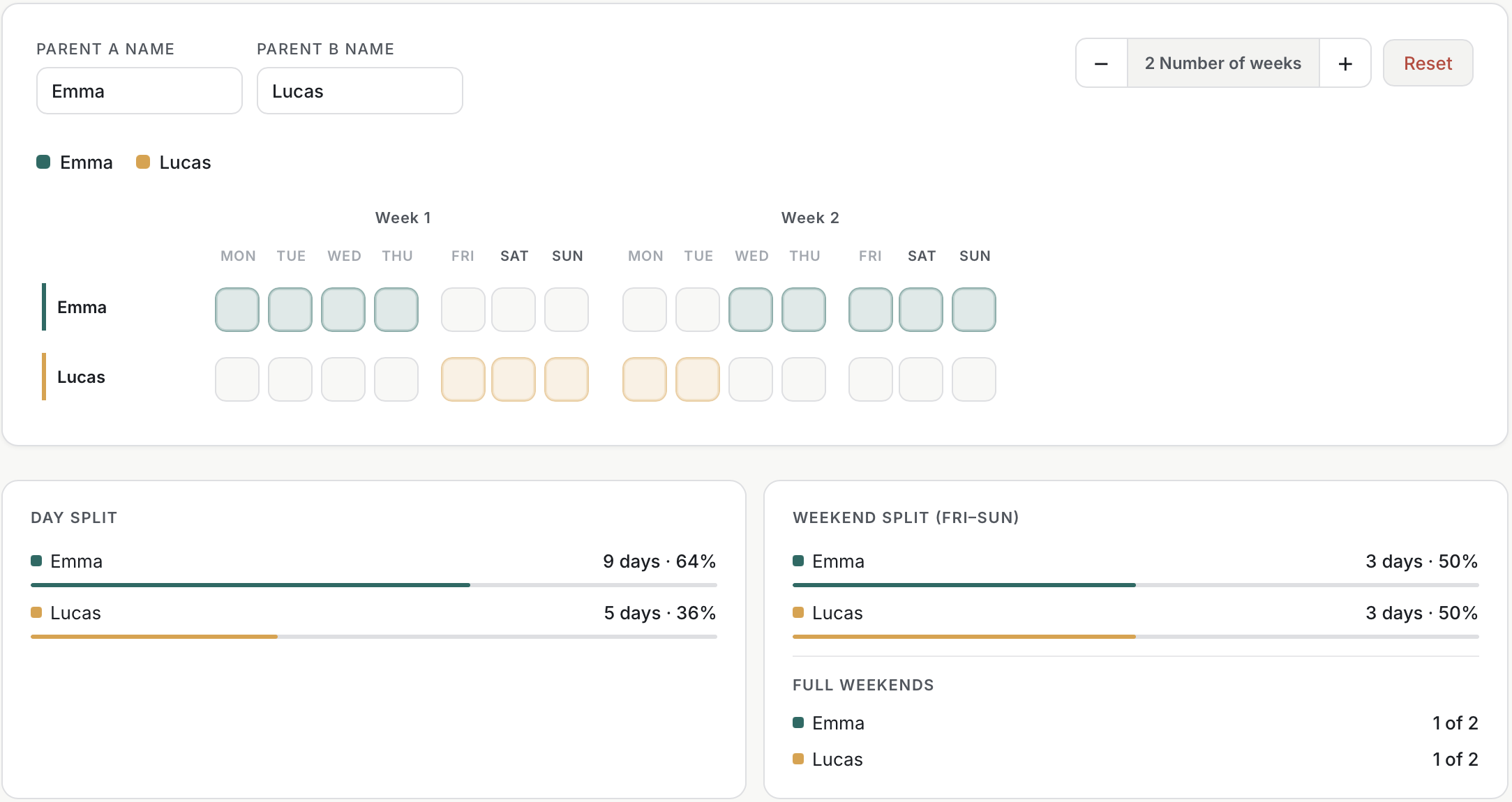
Alternating weeks, from Monday morning to the following Monday morning. The arrangement takes effect 1 September 2026.
Handovers
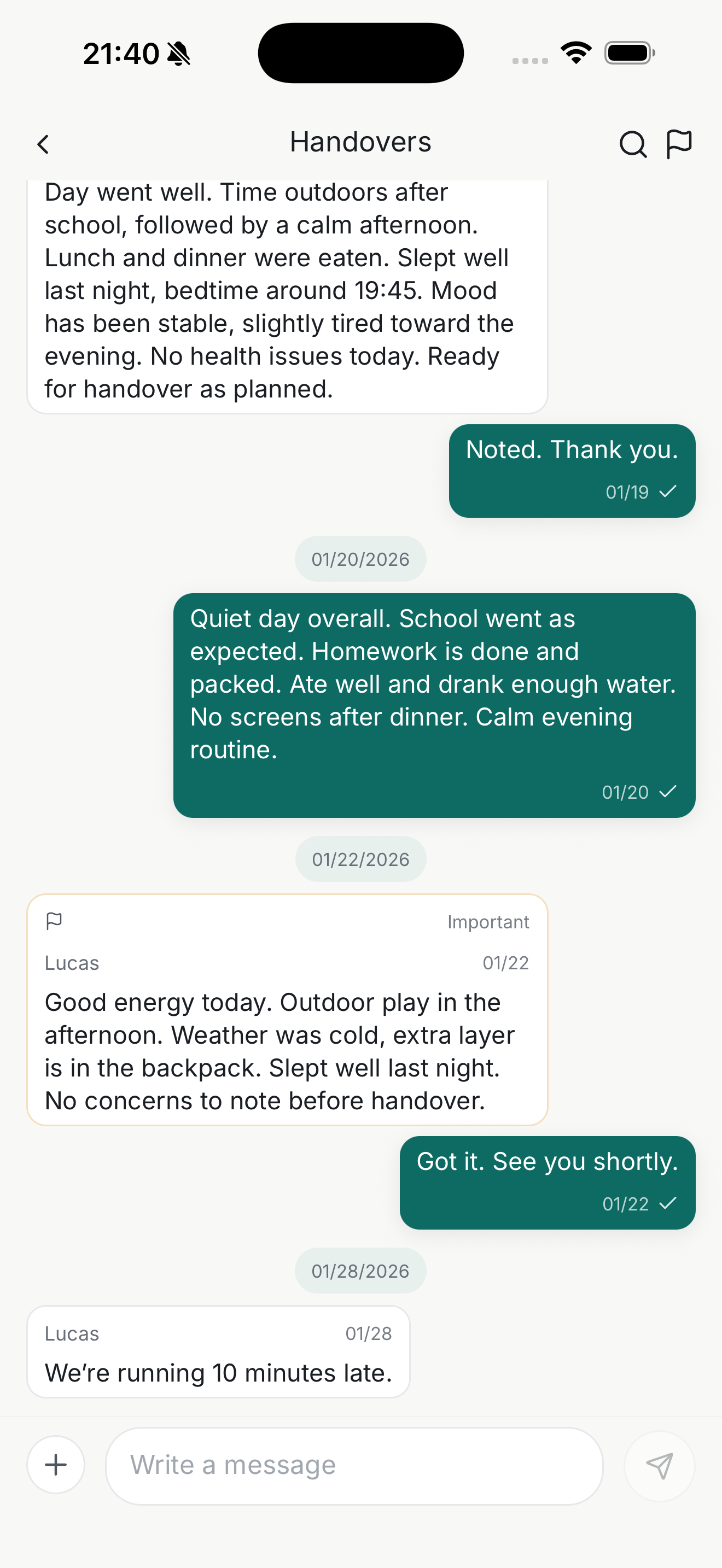
Handovers take place via nursery or school. The parent beginning their week drops Emma off in the morning and assumes parental responsibility from that point. On days when nursery/school is closed, handover takes place at 4:00 pm at the home of the parent whose week has ended.
Holidays and special occasions
Christmas holiday:
The Christmas holiday is divided into two periods: period 1 (23–27 December) and period 2 (28 December – 1 January). Parents alternate between periods each year.
- Parent A has period 1 in even-numbered years and period 2 in odd-numbered years.
- Parent B has period 1 in odd-numbered years and period 2 in even-numbered years.
- Handover between periods takes place at 12:00 noon.
- Allocation is confirmed in writing by 1 November.
Easter holiday:
The Easter holiday runs from the Wednesday before Good Friday through to Easter Monday. Parents alternate each year.
- Parent A has even-numbered years, Parent B has odd-numbered years.
- Allocation is confirmed in writing by 1 February.
Summer holiday:
Each parent may have up to three consecutive weeks of holiday with Emma. Who chooses first alternates each year.
- Parent A chooses first in odd-numbered years, Parent B in even-numbered years.
- Allocation is confirmed in writing by 1 April.
National holiday
Spent with each parent on alternating years.
- Parent A has odd-numbered years, Parent B has even-numbered years.
Half-term and other school breaks:
Follows the regular care arrangement.
Other public holidays:
For public holidays not specifically regulated, the regular arrangement applies. If such a day falls on a handover day, the handover moves to 12:00 noon unless otherwise agreed in writing.
Birthday
Emma's birthday is celebrated with each parent on alternating years. The hosting parent is responsible for organising and covering costs. Close family from both sides may be invited.
- Parent A organises in even-numbered years, Parent B in odd-numbered years.
Contact with the other parent
While Emma is with one parent, she may have phone or video contact with the other 1–2 times per week. The timing is adapted to Emma's routines and mood. Calls are kept brief and calm.
Changes to the schedule
Changes may be made when both parents agree and it is practically feasible. Predictability is prioritised — frequent swaps are avoided. If there is disagreement, the regular arrangement applies.
Communication
Parents communicate in writing about practical matters relating to Emma. The tone should be factual and respectful. Neither parent should speak negatively about the other in Emma's presence.
Travel
Foreign travel with Emma must be notified in writing at least four weeks in advance. Passports are kept with the parent at whose address Emma is registered.
Registered address
Emma is registered at Parent A's address. Changing the registered address requires written consent from both parents. In case of disagreement, both parties commit to mediation before any change is made. School placement is discussed no later than one year before school start.
Health and follow-up
Both parents must be kept informed of appointments and assessments relating to Emma's health, development, and follow-up from a doctor, health visitor, or nursery/school. Both have the right to attend consultations and meetings.
Family and relationships
Emma should have the opportunity to build secure relationships with both parents' families and close networks. Both parents should actively facilitate this.
Finances
Ongoing expenses for Emma are covered from a shared account to which both parents contribute an agreed monthly amount. Child benefit is transferred to the same account. Larger or unexpected expenses are agreed in advance. Both parents have full access to the account.
Changes and review
This agreement replaces all previous verbal and written agreements between the parents. Changes are only valid when made in writing and signed by both parties. The agreement is reviewed at least every six months to ensure it continues to meet Emma's needs.
Date and place
James Smith — signature
Date and place
Sarah Smith — signature
This is an example. Adapt the content to your own situation.